
Public PLN – Balancing PLN, Media Literacy, & Public Discourse

During my fifth week of learning, I gained new perspectives and understanding of PLNs. For me, Public Personal Learning Networks (PLNs) are not just about building networks, but more importantly, about sharing and reaping information. Every participant disseminates and receives information, and we all have our own responsibilities and rules. Making good use of PLNs can be very rewarding and is an indispensable step in modern diversified growth.

In the interview “Public Vision: Social Media and Evening News,” Sophie Lui, using her professional position as a news anchor/reporter, clearly explained why “public PLNs” (Public Placement Networks) have both value and costs. My understanding is that for her, social media is like a radar, constantly exploring and updating, allowing everyone to access fresh, first-hand news. However, she also mentioned some common negative impacts such as harassment and negative emotions. She addressed these issues and how to avoid them, using wit and rationality to prevent misleading others, and carefully considering boundaries before posting and publishing. Her thoughts inspired me greatly, making me realize that her theories seem applicable to our own personal PLN situations.

Public interaction with the public presents both benefits and risks, like a double-edged sword. The benefits include rapid dissemination and feedback, similar to how news used to be broadcast at fixed times, but with public networks, information can be shared 24/7, ensuring no participant falls behind in the information age. However, the drawbacks are equally real, such as the spread of rumors and slander. Unlike the physical world with its robust infrastructure like police and courts, the internet doesn’t offer such robust public infrastructure. Even with widespread real-name registration, these phenomena still exist, and these risks must be mitigated through improved judicial systems and online management. Another risk is misunderstanding. For example, software like TikTok can easily manipulate videos with incomplete beginnings and endings, adding voiceovers to distort the truth and mislead the public. Ambiguous information and videos can also lead to negative online impacts. These are all cases that have occurred. Therefore, in today’s diverse society, both offline and online, risks and opportunities coexist. Public networks are a double-edged sword; only by improving policies and management can we significantly enhance their benefits and minimize their risks.

Trust is the foundation of everything. In today’s world where public opinion networks (PLNs) are so widespread and developed, not only do media outlets need basic integrity and ethical standards, but every participant must also possess these fundamental qualities. As the primary disseminators of information, media outlets, appearing as a group, can quickly and immediately access information and news that is relevant to the general public. A fundamental quality is to disseminate information based on facts, understanding the causes and consequences, rather than embellishing facts with biased opinions and misleading the public. Besides the media, frontline professionals also face this challenge, such as police officers, lawyers, and doctors. A particularly interesting example is from late 2018 in Wuhan. A doctor used his social media account to warn the nation about a new virus that could infect the lungs, similar to the 2002 coronavirus, urging everyone to take precautions. Soon after, Chinese state media debunked this claim and criminally detained the doctor. Shortly after, this doctor contracted the virus and died on the front lines of the epidemic. It was later proven that the doctor was not lying; this was the beginning of the COVID-19 pandemic. This case is a classic example of media error—focusing only on impact and not on the facts.

I will manage and operate my social media accounts with utmost care, as they contain contacts of everyone I know and don’t know, including potential employers. All my actions, which I believe are impeccable, involve remaining silent. I will handle all events in my life and conflicts at work appropriately within designated areas to prevent negative impacts from spreading. Regarding news and other events, I will remain neutral, neither forwarding nor taking sides. In today’s information-saturated world, we as individuals lack the ability to distinguish between false information and opaque or asymmetrical information. To prevent further escalation of negative situations, I will remain silent until things are settled. If I were to take over public accounts, such as news company accounts, I would strictly adhere to company and work guidelines when disseminating information, such as: not saying what shouldn’t be said, and ensuring all information is 100% true and reliable. I will strive to minimize the negative impact of public opinion while disseminating information.

In summary, my view on PLN is conservative. Because there is insufficient regulation and punishment, and in order to avoid being misled into being a perpetrator, I currently mostly just accept and understand information, discuss it within my circle of friends to see what everyone thinks, and follow news organizations and local police agencies to stay ahead or not fall behind. I believe this is my management strategy for Personal Networks.

reference

Hegarty, B. S. (2020, February 6). The Chinese doctor who tried to warn others about coronavirus. https://www.bbc.com/news/world-asia-china-51364382
PLN – Inclusion & Community Engagement.

Regarding the diversity of my PLN (Personal Learning Network), I feel it lacks compared to others I’ve observed. However, I enjoy learning about diversity in the present moment. Therefore, I like to hear different voices on social media to understand how this colorful world changes every day. I am constantly learning and updating my worldview and PLN.

In my personal PLN, I’ve learned about the experiences and risks associated with different professions and hobbies. For example, I’ve recently become very interested in diving. Through learning and exposure, I believe I have acquired the relevant amateur knowledge and awareness, laying the foundation for future systematic learning. In addition, I am very concerned about environmental protection and world affairs. I also obtained accreditation from Learn e-course through a free course and exam provided by the United Nations. I will continuously follow current events and trending topics on various social media platforms to ensure I stay informed about the world as it unfolds and try not to fall behind.

In summary, I believe that social media is suitable for the vast majority of young people, at least those around me. Social media has greatly facilitated communication. A simple example is the comment section for every video and post. Furthermore, social media breaks away from conventional chat software, allowing you to make new friends no matter what you’re doing. For instance, on platforms like TikTok, you can follow your favorite bloggers, join fan groups, and so on. On this highly inclusive platform, self-media bloggers and every participating user are flourishing.

Currently, I lack professional expertise. Although I enjoy sharing, compared to other professional bloggers or sharers, my PLN (Personal Network) can hardly amplify other users’ viewpoints. However, I believe there is communication between us; we influence and support each other, amplifying each other’s opinions and stances in the process. But even making friends or communicating on social media platforms today requires caution, because deception is still prevalent on platforms where fabrication is possible. The explosive development of technologies like AI has provided an excellent backdrop for deception, including creating false professional information to monetize, particularly in finance, travel, and outdoor adventure. The existence of such individuals, in the context of social media and the rise of AI, exacerbates the unfamiliarity and aversion most people have towards them, leading to avoidance or distrust and thus damaging the positive environment for communication.

I have deep feelings about employer communication. There are numerous cases of large companies failing in public relations on Douyin (TikTok), and these all started with a seemingly insignificant post or comment. Even though these companies and employers conducted risk assessments, they still couldn’t completely prevent such situations from occurring. I can only say that in today’s ever-changing world, everyone, including employers and companies, is learning and improving. However, I believe these situations will no longer occur in the future, as company policies will become increasingly sophisticated, minimizing the negative risks posed by the media. For example, my current guidelines include: respecting diversity and all groups; prioritizing user privacy when providing services; verifying everything before expressing opinions; and other policies that regulate employee behavior on social media to mitigate risks.

In today’s rapidly changing world, many of us are being pushed along, but we will choose what we believe in. With the development of social media, our communication and exchange are becoming more sophisticated. I look forward to the future media environment and to the impact my improved personal PLN (Public Relations Network) will have on others.

Reference

Jesse Miller. (2026, January 29). EDCI 338 2026 Week 4 [Video]. YouTube. https://www.youtube.com/watch?v=doJgDjA3QPo

Five Moore Minutes. (2025, February 8). Inclusion is not Assimilation: Understanding communities of identity and diversity [Video]. YouTube. https://www.youtube.com/watch?v=5IOGOE_qQfM

Ng, K. (2024, May 9). China: Baidu PR boss sorry for glorifying work-till-you-drop. https://www.bbc.com/news/articles/cz4x5nnpe80o

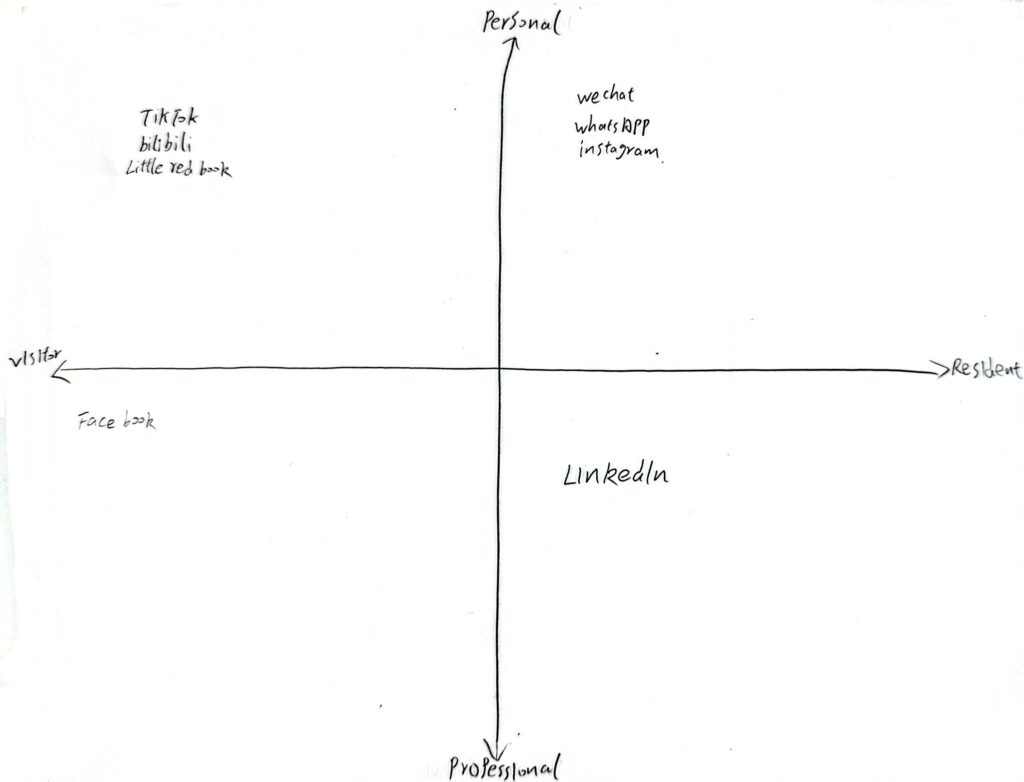
Personal Digital Identity vs Professional Digital Identity

This blog topic has given me a lot of thought. Among the digital platforms I currently use to expand my professional network, LinkedIn stands out as the most useful. Other social media platforms are more for personal use; I don’t use them with a professional mindset, and my posts and daily sharing don’t seem to aim to project a professional image. I believe LinkedIn is a ready-made platform. Its unique existence allows users to showcase their professionalism, such as their resumes and past work experience, when registering an account.

When expanding my professional network, I think resumes, education, and work experience are all factors to consider. We can amplify past challenges and experiences to enhance our expertise in a particular area. I believe educational background, such as specific experiences in our major, is most useful for professional networking. Other potentially influential factors include hobbies and skills.

Regarding employers evaluating my digital identity, I think their reaction will likely be that I enjoy sharing life’s challenges and actively seeking solutions, and I’m willing to use the internet to learn new skills. I believe that in today’s world of advanced technology, not using the internet to learn new content and skills would be a waste of resources. And I’m also someone who loves life and is positive and proactive.